
All Minds on Math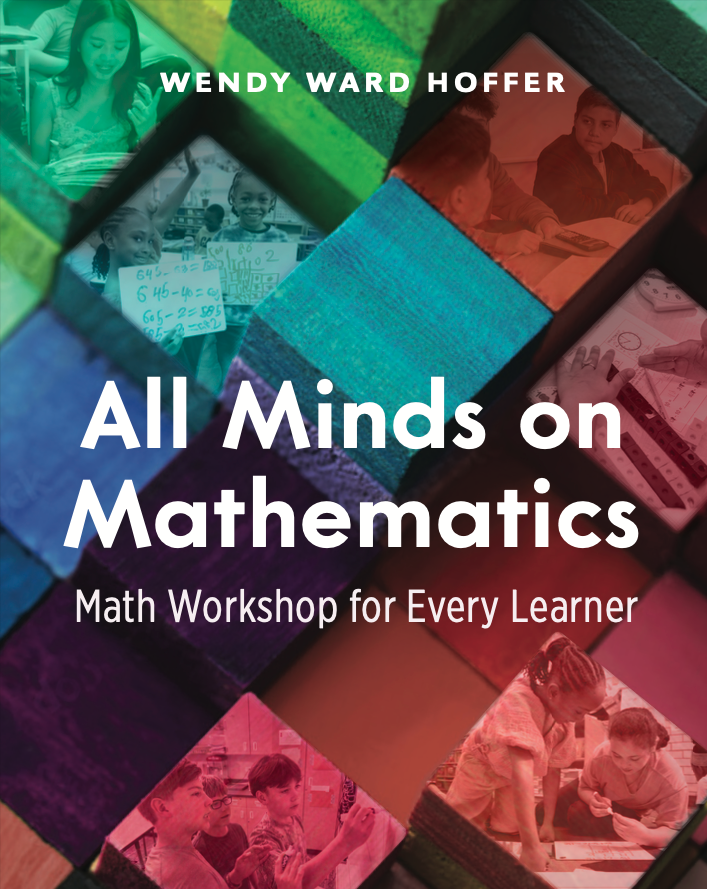
(excerpted from Wendy Ward Hoffer’s newest book, All Minds on Mathematics, coming spring 2026 from Heinemann)
“I see you, I believe in you. You are safe to grow and thrive here. I want to hear your voice.”
– Jamila Dugan and Shane Safir
A couple of years ago, I entered an elevator in an office building downtown and reached over to press the button for the fourth floor, where I was headed. (I know, I could have taken the stairs.) A young woman dove in behind me as the door was closing and extended her hand up the tall column of buttons for the “9.” Feeling chatty, as I usually do, I asked her, “What’s on the ninth floor?”
“A small engineering firm,” she shared, shyly.
“Oh. Are you an engineer?” I asked.
“Yes,” she affirmed, looking me square in the face now. “And you were my middle school teacher.”
I asked for her name, as I did not recognize her all these years later, and came to realize that a once-meek seventh grader now occupied a wide glass-walled office with a beautiful view of the city where she worked to design more of it. When we got to my floor, I stepped out thinking how this young woman had, quite literally, risen above me, her once-teacher. This is, in fact, my hope for all learners: that they each, in their own ways, rise above the generations before, reach beyond us, the families and educators who raise them.
And yet, for many of our students, still even today, access to mathematical heights is limited.
Why Math Matters Most
While every content area deserves attention, mathematics is unique in its liberatory possibilities. Students with strong math skills:
- Demonstrate higher levels of self-confidence and agency;
- Identify as problem solvers with the tools and stamina to persevere through life’s challenges;
- Gain access to advanced coursework in high school and beyond;
- Succeed on standardized tests that provide access to higher education and scholarship support;
- Earn the credentials to enter STEM jobs and other lucrative positions;
- Ensure international competitiveness in technology and other generative fields;
- Pass on math confidence to their families, advancing generations.
For these reasons, math is often identified as a “gatekeeper” subject, one with the power to open potential future pathways. Conversely, students who do not pass high school algebra by the end of ninth grade have only a one in five chance of graduating high school (Gates, 2021).
Why All Minds on Math?
My work as a math educator is centered on three convictions:
- Numeracy is a civil right.
- We are all capable mathematicians.
- Math is about making sense.
I wrote Minds on Mathematics in 2012. A middle school math and science teacher turned teacher educator, this was my second publication synthesizing research and practice in ways that were accessible for teacher audiences of all experience levels. The book’s title was derived from the idea that learning needs not only to be hands on, with math manipulatives and other experiential invitations to develop understanding, but also minds on, with ample opportunities for thinking and reflection amidst all the action. That book presented math workshop as a forum for engaging students in rigorous math tasks aligned to the Common Core Standards for Mathematical Practice supported by student discourse and the resource of thinking strategies. I stand by it.
The purpose of this book is to create a vision for effective mathematics instruction, as well as to provide teachers with the stances, strategies, tools and skills needed to actualize high quality learning experiences for all students. This text pulls together three important fields of study: effective math pedagogy, culturally responsive teaching and social-emotional, trauma-informed practice. It also draws on PEBC’s four decades of work supporting schools and systems in honoring and uplifting children’s innate capacity as thinkers. The first two chapters lay out a vision for our students as capable mathematicians (Chapter 1) and then a vision for ourselves as math educators focused on our own and our students’ assets (Chapter 2). The balance of the text is devoted to articulating the design and facilitation of effective math workshops to those ends, chunk by chunk, named by purpose: Safety, Inspiration, Challenge, Support and Growth.
Mess about with these ideas. Your math workshops will evolve to be unique and beautiful reflections of your own strengths and vision. If students are thinking as mathematicians, you are doing it right!
