How would you describe a workshop? Perhaps it’s a place to tinker, build, create, and ideate. You might picture a space that’s a little messy, or at least full of useful materials. It’s not particularly quiet; instead, there’s a steady buzz of productivity. In many workshops, an expert craftsperson works alongside an apprentice; learning unfolds through trial, error, coaching, and discovery. Rarely is the first attempt the best; there is constant approximating and problem-solving that leads to mastery.
Learning workshops in schools mirror these real-world spaces.
Imagine a lively group of fourth graders trying to make sense of the Revolutionary War. Teacher Jamie Salturelli from Bill Roberts, K -8 begins Literacy Workshop with a quick simulation of taxation without representation: Jamie collects payments from students based on who has sisters, who has pets, and whose shoes have laces. This starts off a spirited discussion of what’s fair.
After activating schema from last week, Jamie models how she determines importance when reading informational text, reminding students of the metaphor of a colander. Her purpose as a reader is to hold onto what is most important. She demonstrates ways to annotate the text and how to hold onto the most important ideas by recording those in a three column chart. Students are paired with reading buddies and invited to read the passage through the lens of determining importance.
The room comes alive with reading, as students debate what’s most important to record, annotate, reread, ask questions, and document important ideas. There is a productive buzz of academic discourse. Jamie confers with pairs and coaches with questioning. “Who were the Sons of Liberty? Why were they important?” “So what was the impact of the Boston Tea Party?” She even supports partners with their collaboration and navigation of shared work. After a solid 35 minutes of reading, annotating, recording, and discussion, students join Jamie for reflection.
Ideas are shared and goals are set for tomorrow. Everyone feels a little bit smarter about some of the events leading to the Revolutionary War. Jamie sees that her students’ next step will be to synthesize the information and solidify the cause and effect relationships that lead to the Revolutionary War.
As Jamie’s classroom workshop demonstrates, students are apprentices, carefully guided by teachers who serve as mentors and coaches. The work is meaningful and lifeworthy, grounded in purpose and relevance. Students are given opportunities to try, revise, and grow, developing both skill and confidence over time.
Central to any meaningful workshop is worthy work—work that invites students to dive in and grapple, applying content knowledge in unique and engaging ways. The workshop model provides a structure that allows students to think and act as readers, writers, problem-solvers, historians, musicians, artists, athletes, and linguists. In doing so, they apply skills and content aligned to standards through authentic tasks.
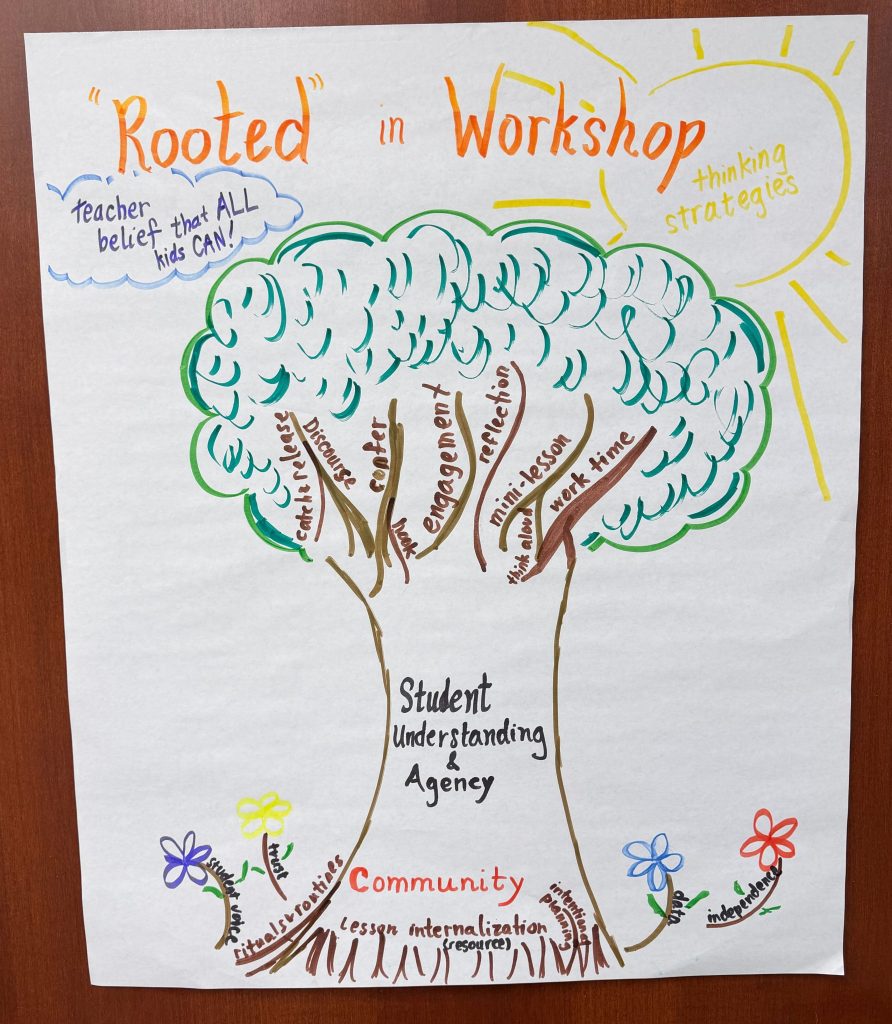
In addition to thoughtful guidance, lively spaces, and worthy work, effective workshops prioritize time—time for students to actually do the work. The structure itself is simple, but powerful:
The Hook or Opening
The class begins by activating thinking. Students might connect to prior knowledge, ask questions, or wrestle with a compelling prompt or challenge. This moment isn’t just about building community; it’s about sparking curiosity and setting the intellectual tone for the day.
The Mini-Lesson
The teacher offers a brief, focused lesson, modeling a skill or strategy students are working to develop. This is intentional and concise—just enough to equip learners for the work ahead.
Work Time
This is the heart of the workshop and takes up the majority of the time. Students apply new skills, explore content, and make meaning (independently or collaboratively). They engage in discourse, utilize their thinking strategies, and solve problems.
Meanwhile, the teacher confers with individuals and small groups, asking questions like:
How’s it going? What are you working on today? Where are you finding success? What’s challenging? Oftentimes teachers link their questions to the learning target or success criteria. This ongoing assessment allows the teacher to provide targeted coaching and responsive support.
Reflection or Debrief
The workshop closes with reflection. Students consider what they learned, how they grew, and the processes they used, verbally or in writing. Reflection is like a metaphorical backpack ~ an opportunity to gather and secure learning so it doesn’t spill out as they move on to the next part of their day.
The workshop model creates the conditions for meaningful, engaging work where thinking, problem-solving, and growth are prioritized.
Check Out more about the Workshop Model in Phenomenal Teaching by Wendy Ward Hoffer.
